
A Software Bill of Materials Is Just Knowing What You Ship
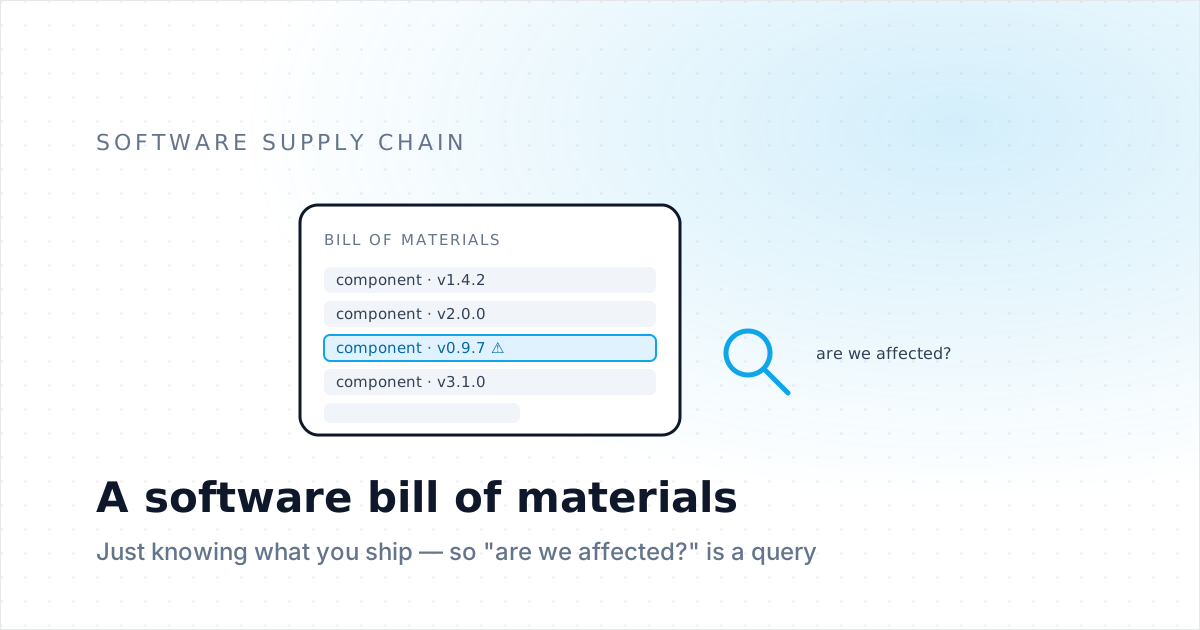
An SBOM isn't compliance paperwork — it's a current inventory of everything your software is made of, so 'are we affected by this vulnerability?' is a query, not an archaeology project.
There is a particular kind of scramble that every software organisation should want to avoid.
A critical vulnerability lands. The security team is asking questions. Customers are asking questions. Leadership is asking questions. Someone asks the only question that really matters:
"Are we affected?"
Then the archaeology begins.
Which products use that library? Which services include it directly? Which ones pull it in transitively? Is it in the application code, the container image, the base operating system, or a build tool? Which version shipped to production? Which customers received which release?
In a well-run system, that question should be answerable quickly.
In too many organisations, it becomes a repo-by-repo investigation under pressure.
That is the real value of a software bill of materials. Not the document. Not the compliance artefact. Not the vendor questionnaire.
The capability.
An SBOM is just knowing what you ship.
You mostly ship other people's code
Modern software is assembled far more than it is written.
Of course your team writes code. But your product also includes frameworks, libraries, SDKs, package-manager dependencies, transitive dependencies, container base images, operating-system packages, build tools, vendored code, generated assets, and sometimes commercial components.
A lot of that code was not chosen directly by your team.
You added one dependency. It brought five more. One of those brought another ten. A base image added system packages nobody thinks about until a CVE lands. A build process pulled in tooling that was never part of the application architecture diagram, but still matters to the integrity of what you ship.
That is not a criticism. It is how modern software works.
The problem is pretending we are only responsible for the code we wrote.
We are responsible for the software we ship.
That includes the pieces we chose, the pieces our tools chose for us, and the pieces nobody remembers choosing at all.
What an SBOM actually is
An SBOM is a machine-readable inventory of the components that make up a piece of software.
At minimum, it should tell you what components are present, what versions they are, how they relate to each other, and ideally where they came from. In practice, a useful SBOM also helps with licences, provenance, hashes, package identifiers, dependency relationships, and release context.
The important part is that it is not just a document someone updates before an audit.
It is structured data.
That matters because the main question is operational: can we query it when we need to act?
Open standards exist. SPDX and CycloneDX are mature enough that the format is not the hard part. The hard part is discipline.
Generating the SBOM consistently. Capturing the parts people forget. Keeping it current. Storing it with the release. Wiring it into the processes that actually reduce risk.
That is where the value appears.
The forgotten parts matter
The first version of an SBOM programme often focuses on application dependencies.
That is a good start, but it is not the whole product.
If you ship containers, the base image matters. If you install operating-system packages, they matter. If you vendor code, it matters. If you bundle a runtime, it matters. If your build process pulls in tools that influence the final artefact, those tools may matter too.
A vulnerability does not care whether the component came from your package manager, your container image, your operating-system layer, or a copied directory from three years ago.
Neither does a customer.
When they ask whether they are affected, they do not want a philosophical distinction between "our code" and "the environment around our code." They want to know whether the thing running in production contains the affected component.
That is the bar.
The SBOM should represent what you actually ship, not just the easiest layer to scan.
The value is answering one question fast
The most important SBOM use case is simple:
Are we affected, and where?
When Log4Shell landed, a lot of organisations discovered that they did not really know where Log4j existed across their estate. When the xz Utils backdoor was disclosed, the shape of the question was different, but the pressure was familiar: which systems, images, distributions, or build paths might contain the affected versions?
These events are useful cautionary tales because they expose the same weakness.
The painful part is not only the vulnerability. It is the uncertainty.
Without inventory, uncertainty becomes manual investigation. Manual investigation under pressure is slow, noisy, and error-prone. People search repositories. They inspect lockfiles. They ask teams to self-report. They inspect running systems. They chase stale documentation. They hope nothing was missed.
With a current SBOM, the first response is different.
Search the inventory. Identify affected artefacts. Prioritise what is exposed. Confirm exploitability. Patch, rebuild, redeploy, or mitigate.
It is still work. But it is not archaeology.
That difference matters.
Generate it in the pipeline
A hand-maintained SBOM rots immediately.
The only SBOM I trust is one generated as part of the build and tied to the artefact being released.
That does not mean the first implementation needs to be perfect. But the direction should be clear: every meaningful release should produce an SBOM automatically, store it somewhere accessible, and associate it with the version that actually shipped.
This is important because software changes constantly.
Dependencies change. Base images change. Transitive dependencies change. Patch releases change. Build tools change. The same repository can produce different artefacts depending on configuration, environment, and release path.
A stale inventory is worse than an honest admission that you do not know.
At least ignorance creates urgency. A stale SBOM creates false confidence.
So the SBOM should be an output of the system, not a side document near it.
Build the artefact. Generate the inventory. Store both. Make them traceable.
That is the habit.
An SBOM has to be consumed
The second failure mode is generating SBOMs nobody uses.
The file exists. It gets attached to a release. Maybe it satisfies a procurement requirement. Maybe it makes an auditor happy. But nothing in the organisation acts on it.
That is checkbox theatre.
An SBOM only becomes useful when it feeds a process.
It should connect to vulnerability scanning. It should support licence policy. It should help security answer exposure questions. It should inform release gates where the risk justifies it. It should be available during incident response. It should be useful to procurement and customer assurance when enterprise customers ask what is inside the product.
The document is not the point.
The workflow is the point.
If a critical vulnerability is disclosed and the SBOM does not help you answer exposure faster, then the organisation has produced an artefact without building the capability it was meant to represent.
That is not enough.
Licence and provenance are part of the same picture
Security tends to dominate the SBOM conversation, but the same inventory is useful for other reasons.
Licensing is one. If you do not know which components you ship, you do not know what obligations come with them. That might be fine for a small internal tool. It is not fine when you are selling software, distributing binaries, embedding components, or working with enterprise customers who care about legal exposure.
Provenance is another. Where did this component come from? Was it fetched from a public registry? Was it mirrored internally? Was it built from source? Was it modified? Was it vendored? Can we reproduce the artefact?
These questions tie directly into dependency ownership.
In my build-versus-buy-versus-bend framing, a dependency always has an operating cost. An SBOM helps make that cost visible. It shows what you rely on, what you have inherited, and what you may need to patch, replace, justify, or support later.
That visibility is not bureaucracy.
It is operational hygiene.
The checkbox trap
SBOMs are increasingly showing up in regulation, procurement, customer assurance, and board-level supply-chain conversations.
That attention is useful, but it also creates a trap.
Organisations start producing SBOMs because someone asked for one, not because they have built the operational muscle behind it.
That leads to incomplete inventories, stale release artefacts, formats nobody consumes, and dashboards that look reassuring until the next incident asks a sharper question.
A stale or partial SBOM can be worse than none because it manufactures confidence.
The goal is not to say, "Yes, we have an SBOM."
The goal is to say, "Yes, we know what we shipped, we can query it, and we know how to act on what it tells us."
That distinction matters.
Compliance should be the byproduct of the capability, not the substitute for it.
Knowing what you ship
A software bill of materials is not a silver bullet.
It will not prevent every vulnerability. It will not solve dependency risk by itself. It will not tell you whether a vulnerability is exploitable in your specific runtime without additional analysis. It will not replace threat modelling, secure defaults, patch discipline, or good engineering judgement.
But it gives you something foundational.
Inventory.
And inventory changes the conversation.
Without it, every supply-chain incident begins with uncertainty. With it, the first move is a query.
That is why I think SBOMs belong in the normal engineering lifecycle, not in the compliance drawer.
Generate them in the build. Keep them current. Include the layers that actually ship. Store them with releases. Wire them into vulnerability scanning, licence checks, release gates, and incident response. Treat them as operational data, not paperwork.
A software bill of materials is just knowing what you ship.
Get that right, and "are we affected?" becomes a question you can answer.
Skip it, and it is the question that ruins your week.