
An AI Adoption Strategy for Engineering Orgs (Beyond Copilot Licences)
Buying everyone AI licences isn't a strategy. A real one decides where AI creates leverage, how you vet the tools, the guardrails around them, and how you'll know it worked.
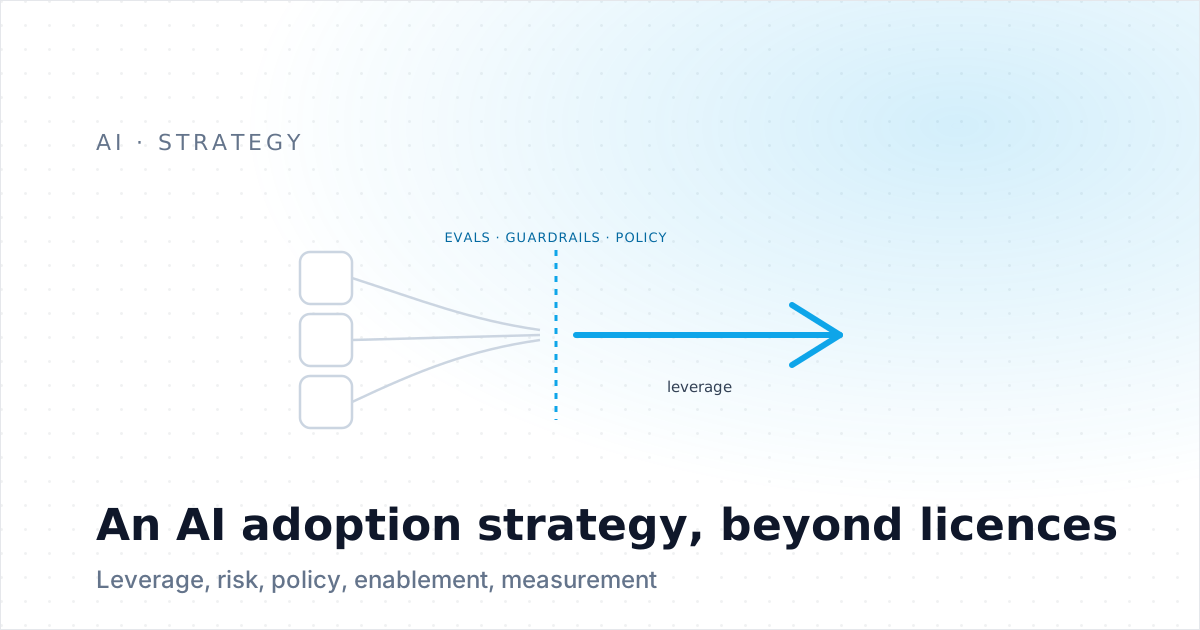
There is a version of AI adoption that sounds strategic but is really just procurement.
Buy a set of licences. Announce that the engineering team is now AI-enabled. Maybe share a few usage dashboards. Maybe point to some completion counts, chat activity, or anecdotes about people moving faster.
Then nothing much changes.
The team is still blocked in the same places. Review quality is the same. Delivery has not improved. The juniors are leaning on tools in ways nobody is really watching. The security policy is vague. The highest-leverage workflows are untouched. The organisation has spent money, but it has not made a strategy.
I am optimistic about AI in engineering teams. I have written before about why AI coding tools are a real productivity lever when they amplify judgement rather than replace it: AI Coding Tools After the Hype.
But that is the individual view.
At the organisation level, the question is different. It is not "should engineers be allowed to use AI tools?" That question is already behind us in most teams.
The better question is: where does AI create leverage for this organisation, under our constraints, without eroding the fundamentals we rely on?
That is a strategy question.
And a pile of licences is not a strategy.
Usage is not value
The licence-as-strategy trap is attractive because it is easy to measure.
How many seats did we buy? How many people activated them? How many completions were accepted? How many prompts were sent? How many chats were started?
Those numbers are not useless, but they are not the outcome.
Usage is not adoption. Adoption is not value.
A team can use AI constantly and still ship the wrong things slowly. A team can accept thousands of code completions and still increase defect rates. A team can generate more code, more documents, and more tickets while creating no more customer value.
This is where engineering leaders need to be careful.
The point of AI adoption is not to look modern. It is not to maximise tool usage. It is not to say every workflow has an AI step because the board expects it.
The point is to remove real drag from the system.
That requires choosing where to focus.
Decide where AI creates leverage
The worst AI adoption plan is "everywhere at once."
It produces noise. Every team experiments in isolation. Tooling fragments. Policy lags behind usage. Leaders get anecdotes instead of evidence. Some people get genuine value, others get theatre, and nobody can tell the difference.
I prefer to start with the places where the organisation already feels friction.
In engineering, that might be developer workflow: code explanation, test scaffolding, boilerplate, unfamiliar APIs, refactoring support, documentation, debugging assistance, or helping engineers understand a codebase faster.
It might be support and operations: incident summaries, runbook assistance, log explanation, alert triage, support ticket classification, or turning repeated manual diagnosis into a more consistent workflow.
It might be internal knowledge: finding the right architectural decision, summarising design records, answering "how do we do this here?", or making standards and paved paths easier to apply.
Those are different surfaces. They have different risk profiles. They need different guardrails.
The strategic move is not to declare AI useful in general. The strategic move is to pick a few high-friction surfaces where the value is plausible, the risk is understood, and the team can measure whether anything improved.
That is how you move from enthusiasm to operating model.
Vet tools like dependencies
AI tools are not just productivity toys. They are dependencies.
That means they deserve the same seriousness we would apply to any dependency that enters the engineering system.
What data leaves our boundary? Does source code go to the provider? Does customer data enter prompts? Is the data retained or used for training? Can we configure that? What access controls exist? What audit trail do we get? What happens if the provider changes behaviour, pricing, or model quality?
The build-buy-bend lens applies here.
Sometimes buying a tool is the right call. Sometimes extending an existing platform is enough. Sometimes self-hosting or building a thin internal layer makes sense because the data, security, or workflow constraints justify the ownership.
But none of those choices are free.
A vendor can create lock-in. An internal wrapper can become a platform. A self-hosted model can create operational work the team is not staffed to carry. A cheap tool can become expensive once usage grows. A beautiful demo can fail when evaluated against the actual work.
So I want evals before broad rollout.
Not academic evals. Practical ones.
Can the tool handle our common workflows? Does it degrade gracefully on edge cases? Does it produce output that meets our standards? Does it help with the work we actually do, or just the work that demos well? Does it introduce security or review risk? Does it make junior engineers faster at learning, or faster at bypassing learning?
A tool that cannot pass a small, honest evaluation should not become an organisation-wide dependency just because the category is exciting.
Policy is part of the product
AI policy cannot be an afterthought.
If engineers are using these tools, the organisation needs clear rules for data handling, prompt content, review accountability, and acceptable use.
What may go into a prompt? What must not? Can proprietary source code be sent to external tools? Can customer data be included? What about logs, production traces, credentials, architecture diagrams, incident details, or commercial information?
These questions should not be left to individual interpretation.
The same applies to generated code and generated documents.
My position is simple: if you ship it, you own it.
It does not matter whether the code was hand-written, generated, accepted as a completion, or adapted from a chat. The author is accountable for understanding it. Review still owns correctness. Standards still apply. Security-sensitive changes still need the right scrutiny.
Generated work gets no free pass.
There are also intellectual property and licensing questions. Teams need to know how the organisation thinks about model output, copied snippets, third-party code suggestions, and attribution. The details depend on the legal and regulatory environment, but silence is not a strategy.
Good policy should not be a wall of fear. It should make safe usage obvious.
That means clear examples. Clear boundaries. Clear escalation paths. A sensible distinction between low-risk and high-risk use. Enough guidance that people can move without guessing.
Enablement beats mandate
I do not think top-down mandates create good AI adoption.
They create compliance theatre.
People say they are using the tools. Teams add AI into workflows where it does not help. Leaders get a sense of momentum. But the actual habits do not change in a useful way.
Enablement works better.
That means training people on where the tools are useful and where they are dangerous. It means showing examples from the team's actual codebase and workflow, not generic demos. It means creating paved paths: approved tools, example prompts, review expectations, templates, documented patterns, and safe defaults.
It also means finding champions.
The best adoption often comes from credible engineers showing other engineers where the tool genuinely removes drag. Not hype. Not magic. Just useful patterns that fit the way the team already works.
This is especially important because AI adoption is not only a tooling change. It is a behaviour change.
People need to learn when to trust the tool, when to challenge it, when to use it as a tutor, when to use it as a draft generator, and when not to use it at all.
That judgement is the asset.
The organisation's job is to protect and scale it.
Measure outcomes, not seats
If the strategy is real, the measurement should be real.
I do not care much about raw completion counts. I care whether the team is better.
Did cycle time improve in the workflows we targeted? Did review quality hold? Did defect rates move? Did support toil reduce? Did incidents get easier to understand? Did onboarding become faster? Did engineers spend less time on mechanical work and more time on design, validation, and delivery?
These are harder to measure than licence usage, but they are much closer to value.
The measurement should also include negative signals.
Are generated changes creating more review burden? Are juniors submitting code they cannot explain? Are engineers spending more time prompting than thinking? Are teams creating new security risk? Are we shipping more code without better outcomes?
AI can create a lot of motion. Motion is not the goal.
The goal is leverage.
Protect the fundamentals
The most important part of an org-level AI strategy is the part people often avoid because it sounds less exciting.
Protect the fundamentals.
If AI becomes a way for engineers to avoid learning the underlying systems, the organisation is borrowing against its future capability. That is especially true for junior engineers.
I do not think juniors should be banned from AI tools. That is unrealistic and not especially helpful. But I do think leaders need to be deliberate.
A junior using AI to understand a code path, compare approaches, generate a first test scaffold, or learn an unfamiliar API can be doing exactly the right thing.
A junior using AI to produce code they cannot explain is a problem.
At an organisation level, that becomes a policy and culture question. What do reviews ask for? What do mentors reinforce? What do we expect engineers to explain? How do we make sure AI accelerates learning rather than replacing it?
This matters because the future of engineering teams is not people versus AI.
It is people enabled by AI.
The organisations that benefit most will not be the ones that try to replace judgement with tools. They will be the ones that use tools to give good people more leverage.
I do not want an AI-native organisation in the sense that the people become secondary to the automation.
I want an AI-enabled organisation where people are more effective, more informed, and less buried under mechanical work.
That distinction matters.
Avoid the theatre
A good AI adoption strategy is not dramatic.
It is a set of decisions.
Where do we believe AI creates leverage? Which surfaces are in scope first? Which tools meet our quality, security, and cost bar? What are the guardrails? What data is allowed? Who owns generated work? How do we enable teams? How will we know if it worked? What would make us change course?
That is the work.
Theatre is easier. Buy the licences. Announce the rollout. Share a few demos. Point to usage.
But engineering organisations do not improve because the tooling bill changed.
They improve when better tools meet better judgement inside a system that knows what it is trying to achieve.
That is the principle I would build around.
An AI strategy is not a pile of licences. It is a set of choices about leverage, risk, policy, enablement, and measurement.
Enable deliberately. Measure honestly. Protect the judgement the tools depend on.
AI does not replace people.
It enables them — if you design the organisation that way.